
- Eastgate Hotel, East Legon Accra
- +233 573 475187
- +233 24 710 7405
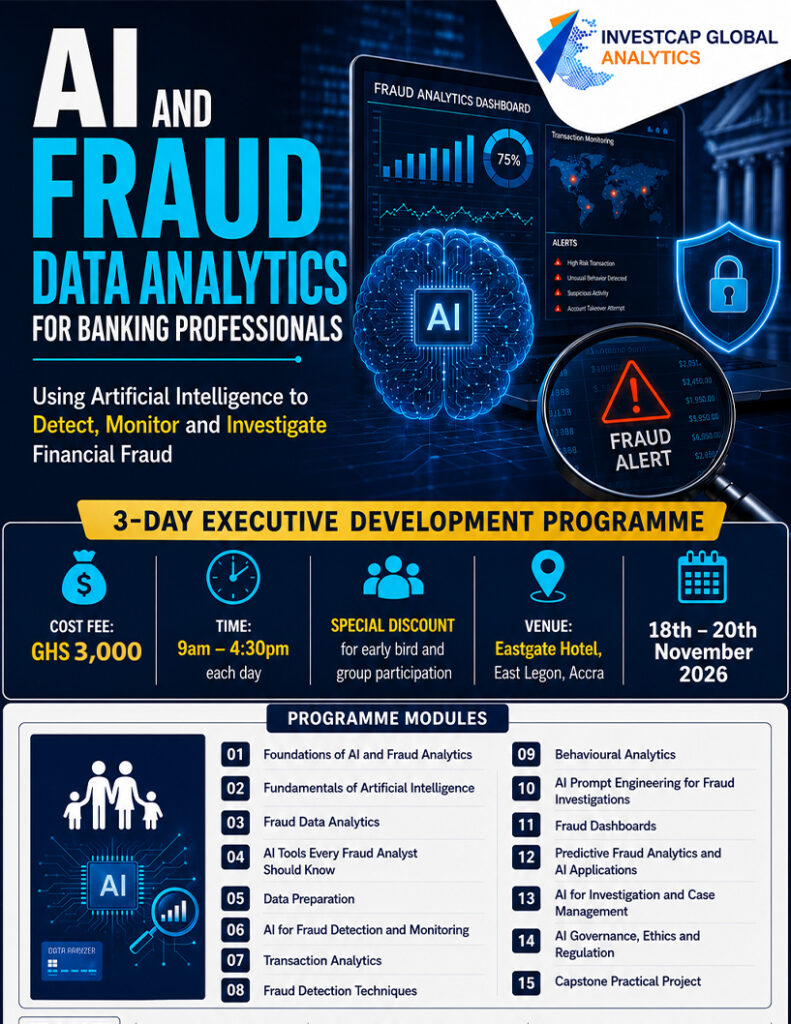
Programme Overview
Financial fraud is becoming increasingly sophisticated as digital banking, mobile payments, artificial intelligence (AI) and cyber technologies continue to evolve. Traditional fraud detection methods are no longer sufficient to combat emerging threats such as account takeover, synthetic identities, payment fraud, insider fraud and AI-enabled financial crime.
This intensive three (3)-day executive programme equips banking professionals with practical knowledge and hands-on skills to leverage Artificial Intelligence (AI), machine learning and data analytics to detect, monitor and investigate fraud more effectively. Participants will explore modern fraud detection techniques, behavioural analytics, predictive models, AI-powered investigation tools and fraud dashboard development using real banking datasets.
The programme combines expert instruction, practical demonstrations, case studies and hands-on exercises to enable participants to build AI-enabled fraud risk management capabilities within their institutions.
Programme Objectives
By the end of the programme, participants will be able to:
- Understand the role of AI in fraud risk management and financial crime prevention
- Detect suspicious banking transactions using AI-driven techniques.
- Analyse fraud patterns, customer behaviour and emerging fraud risks.
- Apply AI tools to support fraud investigations and case management.
- Build interactive fraud dashboards for real-time monitoring and reporting.
- Use predictive analytics to identify emerging fraud trends and high-risk customers.
- Leverage Generative AI to improve fraud investigations and reporting.
- Understand ethical, governance and regulatory considerations surrounding AI.
- Design AI-powered fraud detection and monitoring frameworks for financial institutions.
Target Audience
The programme is designed for:
- Fraud Officers
- Internal Auditors
- Compliance Officers
- Risk Managers
- AML/CFT Professionals
- Operations Managers
- Risk Managers
- Information Security Officers
- Branch Managers
- Fraud Investigators
- Financial Crime Analysts
- Regulatory and Supervisory Professionals
Programme Structure
DAY ONE
Foundations of AI and Fraud Analytics
Session 1: Understanding Banking Fraud
Participants will explore:
- The evolving fraud landscape in banking
- Emerging fraud trends
- Internal versus external fraud
- Cyber-enabled fraud
- Digital payment fraud
- Mobile money fraud
- Card fraud
- Identity theft
- Social engineering
- Insider fraud
Practical Exercise
Participants identify and assess fraud risks within their own institutions.
Session 2: Fundamentals of Artificial Intelligence
Topics include:
- Introduction to Artificial Intelligence
- Machine Learning
- Deep Learning
- Generative AI
- Natural Language Processing (NLP)
- Computer Vision
- Predictive Analytics
- AI applications in financial services
Interactive Discussion
Identifying the most impactful AI technologies for fraud management in banking.
Session 3: Fraud Data Analytics
Participants will learn about:
- Transaction data
- Customer profile data
- Device and channel data
- ATM, Internet Banking and Mobile Banking logs
- Card transaction records
- Call centre records
- Know Your Customer (KYC) information
- Structured and unstructured data
- Big Data concepts
- Data quality management
Hands-on Practical
Exploring and analysing banking fraud datasets.
Session 4: AI Tools Every Fraud Analyst Should Know
Practical demonstrations using:
- ChatGPT
- Microsoft Copilot
- Excel AI
- Power BI AI Visuals
- Google Gemini
- Claude
- NotebookLM
Applications include:
- Fraud investigations
- Risk analysis
- Monitoring suspicious activities
- Report writing
- Executive reporting
Session 5: Data Preparation for Fraud Analytics
Topics include:
- Data cleaning techniques
- Removing duplicates
- Handling missing values
- Detecting outliers
- Preparing fraud datasets for analysis
Hands-on Exercise
Cleaning and preparing banking transaction data using Microsoft Excel.
DAY TWO
AI for Fraud Detection and Monitoring
Session 6: Fraud Detection Techniques
Participants will examine:
Traditional rule-based detection techniques:
- Daily transfer limits
- Multiple failed login attempts
- Dormant account activity
- Velocity checks
AI-powered detection techniques:
- Anomaly Detection
- Behavioural Analytics
- Pattern Recognition
- Predictive Models
Session 7: Transaction Analytics
Participants will analyse:
- ATM transactions
- POS transactions
- Internet Banking
- Mobile Banking
- SWIFT transfers
- RTGS
- ACH transactions
- Mobile Money
Learning outcomes include:
- Identifying suspicious behaviour
- Detecting abnormal transaction patterns
- Identifying high-risk customers
Practical Exercise
Detecting suspicious transactions using sample banking datasets.
Session 8: Behavioural Analytics
Topics include:
- Customer behaviour profiling
- Unusual spending patterns
- Account takeover detection
- Location anomalies
- Impossible travel scenarios
- Device change monitoring
Exercise
Developing customer behavioural risk profiles.
Session 9: AI Prompt Engineering for Fraud Investigations
Participants will learn how to use Generative AI effectively by developing prompts to:
- Identify unusual transaction behaviour
- Summarise suspicious activities
- Detect possible collusion
- Explain fraud indicators
- Rank customers by fraud risk
Specialised prompt libraries will be introduced for:
- Investigators
- Auditors
- Compliance Officers
Practical Exercise
Analysing banking datasets using AI-powered prompts.
Session 10: Fraud Dashboards and Monitoring
Using Microsoft Excel and Power BI to develop:
- Fraud Heat Maps
- Fraud Trend Reports
- Branch Risk Dashboards
- Customer Risk Dashboards
- Daily Fraud Monitoring Dashboards
Hands-on Exercise
Building an interactive fraud monitoring dashboard.
DAY THREE
Predictive Fraud Analytics, Governance and AI Applications
Session 11: Predictive Fraud Analytics
Topics include:
- Moving from reactive to proactive fraud management
- Fraud risk scoring
- Fraud prediction models
- Customer risk profiling
- Early warning systems
Case Study
Predicting fraudulent transactions using historical banking data.
Session 12: AI for Fraud Investigation and Case Management
Participants will use AI to:
- Summarise investigations
- Analyse evidence
- Prepare investigation reports
- Generate interview questions
- Develop management reports
Practical Exercise
Conducting an AI-assisted fraud investigation.
Session 13: AI Governance, Ethics and Regulation
Topics include:
- Responsible AI
- Model bias
- Data privacy
- Data protection
- AI governance frameworks
- Human oversight
- Bank of Ghana regulatory expectations
- Basel principles
- ISO 42001 AI Management System
- FATF expectations on technology-enabled AML/CFT
Interactive Discussion
Balancing innovation with ethical and regulatory compliance
Session 14: Capstone Practical Project
Working in teams, participants will analyse a comprehensive banking dataset containing:
- Customer information
- Transaction records
- Fraud alerts
- Confirmed fraud cases
Using AI, participants will:
- Identify suspicious transactions
- Classify fraud patterns
- Profile high-risk customers
- Recommend mitigation measures
- Develop an executive fraud dashboard
- Prepare an investigation report
- Present findings to a simulated Risk Committee
Practical Case Studies
Throughout the programme, participants will work on realistic banking scenarios including:
- ATM Cash-Out Fraud
- Mobile Money Fraud
- Insider Employee Fraud
- SIM Swap Fraud
- Loan Application Fraud
- Identity Theft
- Card Skimming
- Phishing and Business Email Compromise
- Money Laundering Networks
- Trade-Based Money Laundering
Learning Methodology
The programme combines:
- Expert-led presentations
- Interactive discussions
- Hands-on AI demonstrations
- Real-world banking datasets
- Practical laboratory sessions
- Fraud investigation simulations
- Group discussions and presentations
- Capstone project
- Peer learning and expert facilitation
Key Learning Outcomes
Upon successful completion, participants will be able to:
- Apply AI technologies to strengthen fraud detection and monitoring.
- Analyse banking data to uncover fraud trends and emerging risks.
- Conduct AI-assisted fraud investigations and case management.
- Build executive dashboards for fraud monitoring and reporting.
- Use predictive analytics to identify potential fraud before it occurs.
- Develop AI-enabled fraud risk management frameworks.
- Strengthen institutional fraud governance while ensuring ethical and regulatory compliance.
Programme Deliverables
Participants will receive:
- Comprehensive programme materials
- AI and Fraud Analytics Toolkit
- Sample banking fraud datasets
- Fraud dashboard templates (Excel and Power BI)
- AI prompt library for fraud investigations
- Capstone project materials
- Certificate of Participation
Why Attend?
Artificial Intelligence is transforming the way financial institutions detect, investigate and prevent fraud. Organisations that effectively combine AI with data analytics can identify threats earlier, improve investigative efficiency and strengthen regulatory compliance. This programme equips participants with practical tools, analytical techniques and governance frameworks to build more resilient, intelligence-driven fraud risk management capabilities and safeguard their institutions against evolving financial crime.
Payment Info
BANK
Account Name: Investcap Global Analytics
Bank: CBG
Account Number: 2223987640001
Branch: Kasoa
MOMO
Merchant Name: Investcap De Africa
Merchant ID: 849774